Motion on an Incline: How Mass and Angle Affect Speed
This article uses Sakura Chart to visualize an object sliding down an incline, a standard topic in introductory physics. We compare what happens when the object's mass changes and when the angle of the slope changes.
Like an object in free fall, an object on a fixed frictionless slope undergoes constant acceleration. To keep the comparison clear, we assume no friction (μ = 0) throughout.
1. The Basic Equation
For a frictionless slope at angle θ, the acceleration parallel to the slope is:
a = g · sinθ
Here, g is gravitational acceleration, approximately 9.8 m/s². Notice that mass does not appear in
the equation. Changing the mass therefore does not change the acceleration. On a chart, the curves for different
masses should overlap perfectly.
2. Conditions Used in the Sample Data
- Time:
t = 0.0–2.0 s, in 0.2-second steps - Mass comparison: slope fixed at
30° - Angle comparison:
20°,30°, and40° - Coefficient of friction:
μ = 0 - Masses:
1 kg,3 kg, and5 kg
Velocity and distance are calculated from the constant-acceleration equations:
v(t) = a tx(t) = (1/2) a t²
3. Comparing Different Masses
First, we fix the incline at 30° and change only the mass.
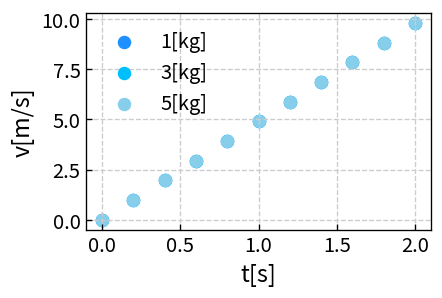
Figure 1. The 1 kg, 3 kg, and 5 kg velocity curves overlap completely.
All three objects gain speed at the same rate. Although a heavier object experiences a larger component of gravitational force, it also has proportionally greater inertia. Mass cancels from the equation, leaving the same acceleration.
4. Comparing Different Incline Angles
Next, we fix the mass at 1 kg and compare slopes of 20°, 30°, and 40°.
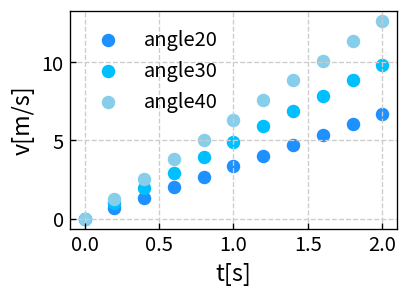
Figure 2. A steeper incline produces a steeper velocity-time line.
As the angle increases, sinθ increases, so the acceleration becomes larger. The object reaches a
higher speed in the same amount of time, which appears as a steeper slope on the graph.
5. Copy the Sample Data
Use the buttons below to copy the same CSV data used for the charts.
5-1. Mass Comparison
The angle is fixed at 30°, with masses of 1 kg, 3 kg, and 5 kg.
5-2. Angle Comparison
The mass is fixed at 1 kg, with incline angles of 20°, 30°, and 40°.
6. Summary
- A steeper incline produces greater acceleration and a faster rise in velocity.
- Without friction, acceleration along a fixed incline is independent of mass.
- Plotting the cases together makes both the overlap and the effect of angle easy to see.
Try changing the conditions in the sample data to build your own comparison in Sakura Chart.