Free Fall and Air Resistance: Why Do Heavier Objects Seem to Fall Faster?
This article compares free fall without air resistance and with air resistance to explain why heavier objects often appear to fall faster in everyday life.
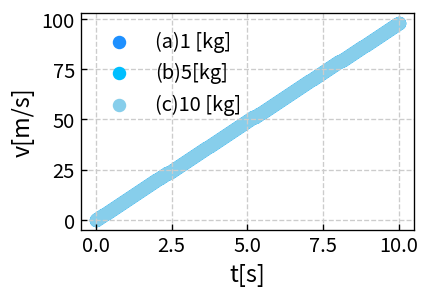
The key visual test is to plot three separate series for 1 kg, 5 kg, and 10 kg objects. In a vacuum, all three series overlap perfectly. With air resistance, the curves separate because the same drag force has a larger effect on an object with less mass.
1. Without Air Resistance: Mass Does Not Change the Trajectory
First consider ideal free fall in a vacuum. Gravity is the only force acting on the object, and every object has the same gravitational acceleration near Earth's surface:
g = 9.8 m/s²For an object released from rest, velocity and distance are:
v(t) = g t
x(t) = (1/2) g t²
Neither equation contains mass. We still create three LEVEL values—1 kg, 5 kg, and 10 kg—but calculate every series with the same equations. When plotted, the three lines lie exactly on top of one another.
2. Why Heavier Objects Often Seem to Fall Faster on Earth
Earth has an atmosphere, and moving objects experience drag. In general, drag:
- increases as speed increases,
- depends on the object's shape and cross-sectional area, and
- causes a larger deceleration for a lighter object when the force is the same.
If two objects have similar size and shape, the lighter object is slowed more strongly relative to its mass. The heavier object is less affected and therefore appears to fall faster.
During the famous hammer-and-feather demonstration on the Moon, both objects reached the surface together because the Moon has essentially no atmosphere to provide significant drag.
3. With Air Resistance: The Curves Depend on Mass
A simple model assumes a drag force proportional to velocity:
dv/dt = g - (k/m) · vg: gravitational accelerationm: object mass (1 kg, 5 kg, or 10 kg)k: drag coefficient in this linear model
The term (k/m) · v becomes smaller as mass increases. The 1 kg object is affected most,
while the 10 kg object reaches a higher speed under otherwise identical model conditions.
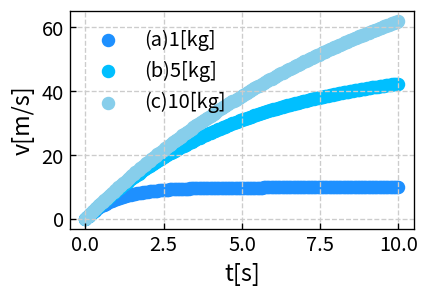
Comparing Figures 1 and 2 makes the distinction clear: the curves overlap when drag is absent and separate when drag is included.
4. Copy-Ready Sample Data
The full datasets are embedded in this page. Use the buttons below to copy tab-separated data for Sakura Chart. Both datasets use the same columns:
t[s]: time in secondsv[m/s]: velocityx[m]: distance fallenLEVEL[kg]: mass label (1, 5, or 10 kg)
For a velocity chart, select t[s] as X, v[m/s] as Y, and LEVEL[kg] as LEVEL.
4-1. No Air Resistance
The three mass levels use identical values and will overlap completely.
4-2. With Air Resistance
In this model, the lighter object approaches its limiting speed sooner, while the heavier object continues to a higher speed.
5. Summary
- Without air resistance, the 1 kg, 5 kg, and 10 kg curves overlap exactly.
- The overlap demonstrates that ideal free-fall acceleration does not depend on mass.
- With air resistance, the curves separate because drag has a larger effect relative to the mass of a lighter object.
- The sample data and Sakura Chart make this difference easy to demonstrate in a class or report.
You can extend the example by changing the drag coefficient or adding an initial velocity to create your own free-fall simulation. Open Sakura Chart to try the datasets.